Thursday, July 12, 2007

Measuring Soil Moisture


One of the linchpins of our early prototype will be soil moisture sensing. We're still figure out how exactly we're going to do this although we are making progress. A big problem with almost all of the soil moisture sensors available is that they are industrial grade. They're big, waterproof, require all sorts of elaborate accessories, and are very expensive. I found a company that creates kits for educational settings, but it comes with one expensive soil moisture sensor and proprietary software that won't work for our application. A couple weeks ago we were just about to purchase some pricey sensors only to discover at the last minute that it required an additional expensive piece of equipment that would not provide a real time data feed without he addition of yet another piece of equipment. So we had to start from the drawing board again.

The only significant body of hobbyists dabbling with moisture sensors seem to be weather geeks who are specifically interested in "leaf wetness sensors" to measure dew. It does seem, however, that much of the hardware and software appropriate for that is also appropriate for soil moisture sensors.

Marcel has volunteered to make the sensors himself based partially on a schematic that Bryant found. It turns out to be pretty easy to make a soil moisture sensor with a bit of electrical engineering know-how and a few dollars. We already have a data acquisition and control device from LabJack. Of course the hard part is getting everything to work together! Now we just have to decided if we're going to go with the homemade set up or with the Watermark sensor. Probably the decision will be made tomorrow. We also have to decide whether to use the moisture meter from
Hobby Boards. We weren't sure if the Hobby Board moisture meter set would work for us, but I found this paper Intelligent Plant Monitoring System online today by Ya-Shian Li. Ya-Shin may have used the moisture meter in conjunction with a home made sensor. Might be some useful clues here how to set up our system and how to write the API at least. As the soil moisture sensing is a means to an end for us, I'm hoping that we will get this part of the system up and running ASAP.


MIT plant sensors


A while ago I ran into this reference to a plant sensor project at MIT tangible bits group. I went back to get more information and I can't seem to turn up anything but this very limited project page (and neither could my friend Mr. Google). Anyone else find anything about this endeavor?

Monday, July 9, 2007

Teracycle's Worm Poop: Composting for Lazy People


While watching an hour or two of Live Earth and saw a presentation by Teracycle on their organic plant food that is made by feeding premium organic waste to millions of worms. The worm poo is liquified into plant food and bottled directly in used soda bottles.

At first I was a little skeptical, I mean everyone knows about feeding your household's organic waste to worms to produce rich, nutritious, free compost, right? But then I realized that even though I have friends who do this and even though I know how easy it is, I don't do it myself. Nor am I really motivated to start. (If you are, here's a website that will help you learn more about composting with worms.)

More food for thought (if not for worms), I have Miracle Gro in my cabinet which is a synthetic fertilizer with problems of its own sustainability-wise. Since we're gardening indoors in containers we don't need to worry about polluting groundwater necessarily, but urea is one of Miracle Gro's main ingredients and according to Wikipedia urea is produced commercially from synthetic ammonia and carbon dioxide and that the production process sometimes involves petroleum-based products. Maybe I'll get some for the Technology Garden. So hey, maybe compost for lazy people isn't such a bad idea after all.

Wednesday, June 27, 2007

Microvoltage Fluctuations in Plants


I saw an interesting sensor technology in an artwork that creates a connection between a bird and a plant--and also human onlookers. "Essay Concerning Human Understanding" was a live, bi-directional, interactive, telematic, interspecies sonic installation Eduardo Kac created with Ikuo Nakamura between. In this work, a canary dialogues over a regular phone line with a plant (Philodendron) 600 miles away.

In New York, an electrode was placed on the plant's leaf to sense its microvoltage fluctuation response to the singing of the bird. The of the plant was monitored through a Macintosh running a software called Interactive Brain-Wave Analyzer (IBVA). IBVA is a program designed to detect human mental activity and was employed to inspect the vital activity of an organism generally understood as devoid of consciousness. The information coming from the plant was fed into another Macintosh running MAX, which controlled a MIDI sequencer.

The yellow canary was given a very large and comfortable cylindrical white cage, on top of which circuit-boards, a speaker, and a microphone were located. A clear Plexiglas disc separated the canary from this equipment, which was wired to the phone system. Not surprisingly, people altered their behavior when around the bird and around the plant.

Kac says about this work: "This interactive installation is as much about creating art for non-humans as it is about human isolation and loneliness, and about the very possibility of communication. As this piece projects the complexities of electronically mediated human communication over non-human organisms, it surprisingly reveals aspects of our own communicative experience. This interaction is as dynamic and unpredictable as a human dialogue." [Thanks to www.ekac.org]

Now I'm trying to figure out if IBVA is something that could be useful for the Technology Garden. I found IBVA's website and still have no clue as to what it is or what it does and how it does it. Sadly, they have a terrible FAQ that is long rant against the evils of greedy marketing and press people. While I sympathize, they really ought to help out their consumers a little here.

I've also found a patent for a device that does something similar. Alas, I have found no actual product.

Thursday, June 21, 2007

Human-Plant-Human Interaction


Lately I've been thinking and talking about what we're doing with the TechGarden in terms of Human-Plant-Human Interaction. Google yields plenty of searchs on people-plant and human-plant interactions but, as Paul Dourish pointed out, Google yields nothing for human plant human interaction. Google says:"Your search - "human plant human interaction" - did not match any documents. " It would probably more accurate to call what we're doing a Human-Plant-Computer-Human Interaction. Well, that yields a terrifically unwieldy acroynym. Maybe it would be good to stick with HPH. Or how about Computer-Human Interaction throughPlants (CHIP)?

The Infotropism project, presented at DIS 2004, is an example of what I'm calling HPH/CHIP. the system uses the properties of phototropism to turn a plant into a living display. Phototropism is directional plant growth in which the direction of growth is determined by the direction of the light source. lights are wired to a recycling bin and a trash bin on either side of the plant. every time something is placed in a bin, the corresponding lamp emits a burst of light. thus, the plant acts as a display of human consumption patterns. [Thanks to ::setbang::].

It's very interesting to think of the plant itself as a display. We weren't necessarily focusing on the notions of plants-as-display, although perhaps we were implicitly: over time, the plants show patterns of human care. The plants in our highly artificial environment will only survive with human care and they will only thrive with persistent human care.

Wednesday, June 20, 2007

Bren Hall Building Dedication


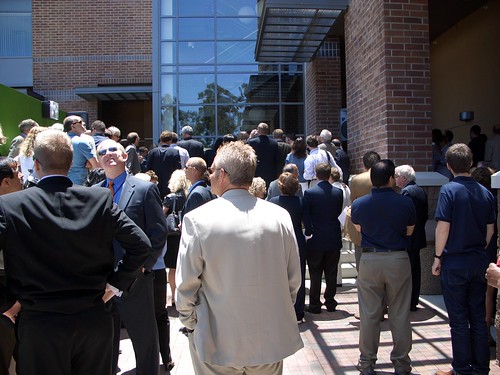
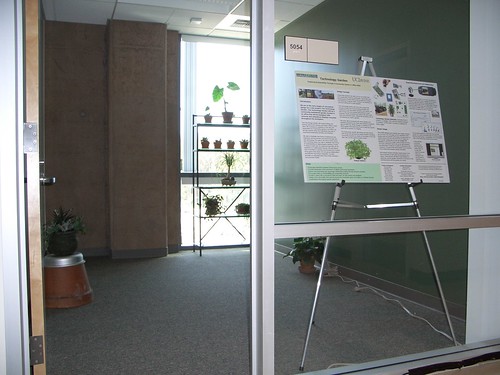
The new Computer Science Building, Donald Bren Hall, was dedicated yesterday and as part of the dedication there was an open house for the public. Several demonstrations were set up around the building while some projects were represented by posters. Our project had two posters: one in the poster room in the Informatics Department and one in the Technology Garden room.

A couple folks came by to chat in the poster room, but the Room complete with poster in the hall-facing window proved to be the big draw. I'm convinced that if the room had been fully set up that we would have gotten a big crowd. Almost everyone was very enthusiasitic and thought it was a great idea or was at least intrigued by it. There were a couple folks who just could not take the idea seriously, but I suppose that is inevitable.

I did get a chance to get the patter down for the project. Talking to folks did help me to focus on what was new and important about this project, and what could be misunderstood. A couple folks thought that we were designing sensors and others thought we were trying to automate plant care. The latter point was especially interesting, because in some ways what we're doing is antithetical to automated plant care. Instead of trying to remove the human element and reduce the dependency on human interviention we are trying to enhance, and build awareness of, the interactions between plants and people. Hmm. This could be good fodder for the CHI paper!

First Plants!


The Technology Garden has it's first signs of life now. Bonnie and I made a trip to Roger's Gardens in Newport Beach to get some beautiful new plants for the Technology Garden. We got a variety of beautiful succulents as well as a bonsai palm, and some tropical plants. We were really gravitating towards sculptural plants with beautiful colors and are pleased with what we found. We are off to a great start.

We will need more big leafy plants. I will be heading back to the nursery soon to get some ficus benjamina and other proven air-cleaning plants to bolster the effect on the CO2 and Oxygen levels in the room. I'm trying to get up to speed on my plant knowledge.

In other news, we've officially welcomed Bryant Hornick to the team. Bryant and I will be working closely this summer to design and develop some of the collaborative plant care applications while most of the other folks on the project are out of town. We will also be working to keep the plants happy until the user study gets into full swing--at which time the users will be largely responsible (or not) for keeping the plants happy.